Boredom, Unemployment, and the Cycle of Youthful Self-Destruction
And Their Children After ThemBoredom, unemployment, and the cycle of youthful self-destruction take shape in the ZUP as more than a lack of things to do: stalled work and business leave young men waiting through the heat, while frustration finds outlets in smoking, fighting, risky driving, and fire. The summer’s repetitive days trap Hacine and his friends between the wish to be elsewhere and the few available ways to break the monotony. Hacine’s ride across town and his decision to ignite a hay roll give this cycle its most vivid form: danger briefly offers him the calm that ordinary life cannot.
The Summer Economy of Waiting
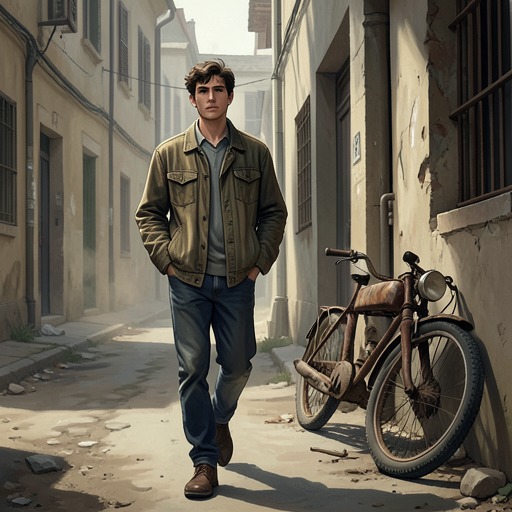
Hacine’s day begins with a walk up the hill to the ZUP Residential District. He buys a Coke and two croissants at a bakery and eats as he climbs; in the already rising heat, the cold drink feels miraculous. In the courtyard, the annual fair has arrived, bringing a bumper-car carousel and a waffle stand. Hacine joins Eliott, who is using an old wheelchair motor after the battery on his own has died. The small, familiar attractions offer a place to gather, but not a way out of the day’s limits.
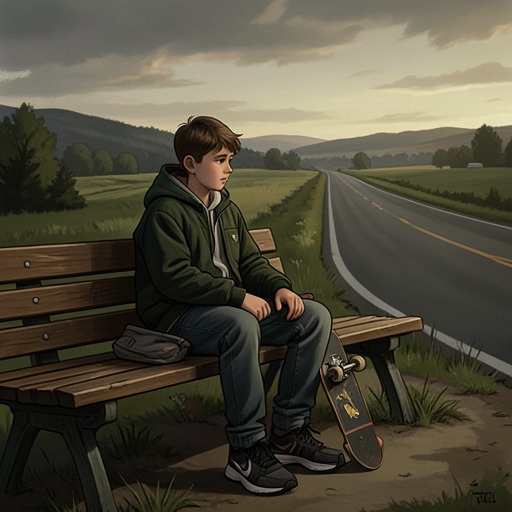
The boys sit in the shade of the boules-court shelter and watch customers come by. For two days, people have left without buying anything. Around them, the buildings remain cube-like and indifferent, while dust moves in the sunlight. After lunch, familiar faces appear in rotation: Djamel, Seb, Mouss, Saïd, Steve, Abdel, Raduane, and Kader, among others. The group may reach ten, though usually five or six boys are there at a time, leaning on a fence or sitting on a low wall, smoking joints and waiting. Friends come and go to handle their business, so the courtyard’s steady stream of company breaks up the hours without changing their basic routine of dealing and waiting.
The older men who stop to talk show another face of the same narrowed economy. Many have settled into temporary work or short contracts at Carglass or Darty. Sami, once the valley’s biggest wholesaler, has opened a kebab stand near the station. Even when he puts on a cheerful front, the boys can sense his anxiety about bankruptcy; he now drives a Peugeot 205 and carries credit-card debt while supporting his two children. Their brief exchange with him brings the consequences of economic decline close to the courtyard: former standing has given way to precarious work and anxious small business. The young men promise to visit later, then return to the suspended afternoon.
Monotony and Fraying Tempers
The day’s heat and lack of activity make tempers volatile. Children cycle back from the swimming pool, and the boys trade teasing, but little else interrupts the wait for the bumper-car stand to open. Heat and boredom can affect people like liquor; sometimes the boys start fights simply to relieve their idleness, after which calm returns abruptly. The pattern is not an escape so much as a brief disturbance inside an otherwise repetitive day.
Hacine is already in a foul mood when he criticizes the others for drinking beer outdoors. His own frustration has specific causes: his scooter has been dead since June, after a cascade of failures in the ignition, cylinders, pistons, rings, and spark plugs, and he has had to walk everywhere. At the same time, hash is scarce. The afternoon stretches into a greasy, almost shapeless duration. The towers seem to sway in the heat; children’s and television sounds disappear from open windows, and only the occasional howl of a modified motorcycle cuts through the quiet. Sweaty, sluggish, and resentful, the boys imagine being somewhere else—at work in an air-conditioned office, or at the seaside. The imagined alternatives make the courtyard feel less like a resting place than a holding pattern.
For Hacine, the wait is also a business crisis. He has not seen ten customers since morning and suspects that new suppliers have drawn demand elsewhere. If the shortage continues, he fears that he and his friends will lose everything. He lets the others know that his brother might help, though he does not believe his brother can be relied on: the man does business with people from Bobigny, lives outside Paris, has not returned to Heillange in at least three years, and does not answer calls. The remaining possible contacts are dangerous, and Hacine recoils from dealing with them. His prospects narrow alongside the afternoon: stalled sales, unreliable family ties, and risky alternatives leave him no dependable route forward.
Speed, Fire, and Temporary Relief
Hacine’s response to this trapped feeling is movement without restraint. He races down the ZUP hill on a Yamaha, then through downtown in third gear, treating the turns as something to anticipate rather than a reason to brake. He does not stop for red lights. To passersby, he is a thin figure with skinny arms emerging from an oversized T-shirt; the sight makes them draw political conclusions. The narration places that public judgment beside Hacine’s private extremity, describing a seventeen-year-old heart caught in barbed wire. Death can seem enviable to him. The ride is therefore not simply freedom in motion: its speed carries the same desperation as the hours he is trying to outrun.
He reaches the departmental highway toward Spain and stops beside a field of enormous hay rolls. Walking across the dry stubble, he takes out an old bronze-colored Zippo and repeatedly snaps it open and lights it on his jeans. The lighter links his present anger to an earlier, small-scale class antagonism. During school examinations held at Louis-Armand, wealthy pupils from the private Hurlevent school were brought into the gray public-school buildings; Hacine had taken the Zippo from one of them. The arrangement had produced occasional thefts and other acts of retaliation, but the rich pupils learned to leave valuables at home, and the boys from the ZUP no longer stole their satchels. On a later occasion, Hacine took the lighter and two guitar capos from long-haired pupils in rock T-shirts. The old lighter is thus both a practical object and a trace of conflicts that no longer yield much.
At the field, Hacine first lights a piece of straw and stamps it out, then lights the hay roll. The fire catches with a crackling rush and spreads along the ground. He steps back to watch, breathes deeply, and feels the remarkable calm that comes over him each time. Only once the hay is burning can he feel ready to go home. When he rides away, the valley behind him seems to be aflame. The image magnifies a private act into a landscape-wide blaze, but it does not suggest that the underlying pressure has been resolved.
A Cycle Without a Way Out
The sequence connects economic stagnation to self-destructive release without reducing Hacine’s choices to a single cause. The group’s days are organized around intermittent customers and small, repeated diversions; the adults’ temporary jobs and anxious businesses offer no convincing image of security. Hacine’s broken scooter deepens his frustration, while the shortage of hash threatens his place in the local trade. Under those conditions, speed and fire provide intense but temporary breaks from helpless waiting.
The contrast between the annual fair and the boys’ dwindling prospects sharpens the cycle. Its lights, rides, and waffles promise seasonal novelty, yet the boys spend the day beneath the shelter, returning to the same routine and the same shortage of customers. Hacine’s flame supplies a more consequential interruption: he can watch something catch, spread, and burn, and the act brings calm. But he leaves on the motorcycle rather than entering a changed life. The ride and the fire convert boredom into immediate danger and momentary relief, while the empty afternoon, precarious work, and uncertain future remain in place.